Friday, December 14, 2007
Star Trails At Dawn 2.7
For this APOD I chose to do the picture of the wide-angle, long exposure of the night sky. It details how the stars near the celestial equator appear to move in almost perfectly straight lines as the Earth rotates on its axis, while the stars to the north and south seem to rotate around the poles. Orion, Venus, Sirius, and an Iridium satellite are all visible in the picture as well. The picture was formed using 477 consecutive 30-second exposures over 4.3 hours.

A Jet from the Sun 2.6
This week I chose to do the picture of a jet of plasma coming from the sun. These jets are a possible explanation for the solar wind, but we do not fully know what specifically causes them. The pictures were taken by the Japanese Hinode satellite and the jets themselves are causes by magnetic reconnection events, in which magnetic field lines quickly move and drag electrons and protons alog with them.
Monday, December 10, 2007
Guided Observation 12/6
Date: 12/6/07
Time: 7:00-9:00
Location: Church off Clark Road Extension
Tools used: Naked Eye, telescope, binoculars, laser.
Light Pollution: Very low, some lights visible to the east , west, and north, but it was minimal.
Cloud Coverage: 7%
Temperature: 60-65 degrees Farenheit
Moon: Not visible, but it was a waning crescent at apogee. 406,000 km approximately from Earth.
Constellations observed: Andromeda, Ursa Minor, Aries, Lyra, Delphinus, Cassiopeia, Cepheus, Pegasus, Perseus, Pisces, Cetus, Cygnus, Aquarius, Taurus, Aquila, Eridanus
Planets: Mars, Uranus
Stars:Mira, Vega, Deneb, Altair, Polaris, Gemini twins, Achernar
Misc: M47, Andromeda galaxy, M36, M103, Comet Holmes
Time: 7:00-9:00
Location: Church off Clark Road Extension
Tools used: Naked Eye, telescope, binoculars, laser.
Light Pollution: Very low, some lights visible to the east , west, and north, but it was minimal.
Cloud Coverage: 7%
Temperature: 60-65 degrees Farenheit
Moon: Not visible, but it was a waning crescent at apogee. 406,000 km approximately from Earth.
Constellations observed: Andromeda, Ursa Minor, Aries, Lyra, Delphinus, Cassiopeia, Cepheus, Pegasus, Perseus, Pisces, Cetus, Cygnus, Aquarius, Taurus, Aquila, Eridanus
Planets: Mars, Uranus
Stars:Mira, Vega, Deneb, Altair, Polaris, Gemini twins, Achernar
Misc: M47, Andromeda galaxy, M36, M103, Comet Holmes
Friday, December 7, 2007
Double Cluster in Perseus 2.5
For this week, I chose to do a picture of a starfield in Perseus near the comet. The two star clusters are visible to the unaided eye and are about 7,000 light years away. It was first seen in 130 BC by Greek astronomoer Hipparchus. They are now known as chi and h Persei, and they both contain stars younger and hotter than the sun. The two clusters have similar ages as well, showing that they both were formed from the same star-forming area.
Friday, November 30, 2007
Galaxies in Pegasus 2.4
This picture shows a number of galaxies that are contained within the constellation Pegasus. It includes one of the brighter galaxies that was not included in Messier's catalog, NGC7331, only 50 million light years away. It also shows Stephen's quintet, which is 300 milllion light years away, and is actually made up of 5 galaxies colliding. Despite these two galaxies appearing on opposite corners of the picture, they are actually only separated by about half a degree.
Friday, November 16, 2007
Rocket Fuel 2.3
This week I chose to do the picture of the Orion and the stars within it, and it also contained a mysterious cloud that looks like a rocket. Upon further investigation, it was discovered to be a fuel dump from a booster rocket that was used to put a satellite into geosynchronous orbit. The time-exposure photograph made it appear like a comet, as it slowly drifted across the photograph.
Friday, November 9, 2007
Comet Holmes Grows A Tail 2.2
For this week, I chose to do a blog on the picture of the comet 17P/Holmes. The comet now appears to be larger than the stars and planets in the sky, and will not move much over the next month. Additionally, the detail in the tail shows that the large increase in the amount of dust and gas that caused the jump in brightness two weeks ago is still occuring.
Friday, October 26, 2007
Enceladus Ice Geysers 2.1
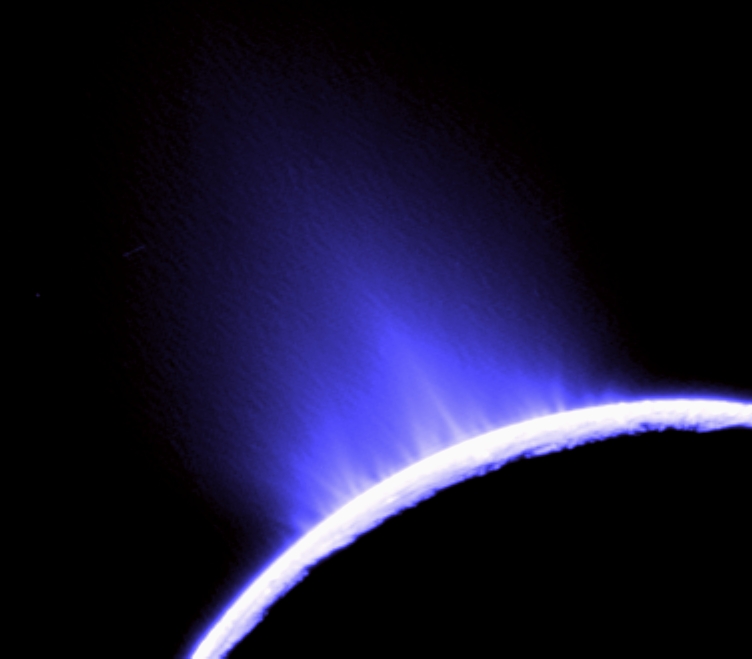
For this week's APOD blog I decided
to do the picture of the ice geysers on Saturn's moon Enceladus. I have never heard of cryovolcanism, but the picture interested me. I found it especialy interesting that these volcanos might be responsible for creating one of Saturn's rings, as well as the fact that moon is actually at -200 degrees Celsius.
Friday, October 12, 2007
Aurora, Stars, Meteor, Lake, Alaska 1.7
I chose to do the picture of the aurora borealis over a lake in ALaska for this week's APOD entry. I'm not sure if they were all taken at the same time, for the picture says that it is a digitally fused panorama, but the end result is utterly fantastic. The scene featuring the aurora and its reflection over the lake, with a meteor shooting beneath it and the stars above it, create a beautifully picturesque image of North Pole, Alaska (the city).
Thursday, October 11, 2007
Nicolas Copernicus
Johnson 1
Colin Johnson
Astronomy Honors I
10/11/07
Mr. Percival
Nicolas Copernicus
Nicolas Copernicus was born in Torun, Poland in 1473. When he grew older, began
to study astronomy, mathematics, and optics at the University of Cracow. His uncle, Lukas
Waterzode, the future bishop of Varmia, influenced him to become a canon at the
Frauenberg Cathedral in Ermland. He spent the vast majority of his life in an academic
setting, going to the University of Bologna and the University of Ferrara to study law, and
the University of Padua to study medicine. His primary interests in the early parts of his life,
however, were the painting and translation of Greek poetry. As he grew older, though,
astronomy began to pique his interest. He made the vast majority of his observations from
the wall of the cathedral with the naked eye for the telescope would not be invented for a
hundred more years. In 1514, he was contacted by the Lutheran Council in order to aid
them in the process of reforming the calendar. In fact, he opposed it, because he knew that
the exact length of the tropical year had not yet been confirmed.
In the year 1539, a mathematics professor by the name of Georg Joachim Rheticus
visited Copernicus, and a year later, he published Copernicus’ theory of the heliocentric
universe in his Narratio Prima (First Report on the Books of Revolution). Copernicus took a
fair amount of convincing to publish his own works, not because he was concerned with the
Johnson 2
church’s outlook on the theories, but simply because, as a perfectionist, he was not sure if
his work was ready yet. However, at the behest of Rheticus, he published his De
Revolutionibus Orbium Coelestium (Onthe Revolutions of the Heavenly Spheres), in which
he detailed his theories of a heliocentric universe in which the Earth rotated on its axis and
revolved around the sun. He also laid down the order of the planets, and the theory (later
proven false) of the planets’s circular orbits. Two months after the publication of his
theories, Copernicus died, in May of 1543.
He died, therefore, before he was able to see the stir caused by his creation.
According to the Bible and the teachings of the time, man was created in God’s image and
therefore is superior to all other parts of nature. However, Copernicus’ theory led men to
believe that, rather than being superior to the universe, they were merely a part of it. This, in
fact, is regarded as one of the most important aspects of his work, that man could no longer
consider himself superior to the rest of nature. Galileo Galilei and Giordano Bruno, both of
whom embraced Copernicus’ beliefs, were persecuted by the church for their heretical
views. Bruno even dared to suggest that our solar system might even merely be one of
many such systems, and for this he was burned at the stake in 1600. Due to his vast
contributions to the science of astronomy and our understanding of the universe we live in,
Nicolas Copernicus can easily be considered one of the most important astronomers of all
time.
Works Cited
Encyclopedia of Scientific Biography.
Kusukawa, Sachiko. "Nicholas Copernicus." 1999. Dept. of History and Philosophy of Science, U of Cambridge. 11 Oct. 2007.
Landry, Peter. "Nicolas Copernicus." The Scientists. Feb. 2004. 11 Oct. 2007.
Colin Johnson
Astronomy Honors I
10/11/07
Mr. Percival
Nicolas Copernicus
Nicolas Copernicus was born in Torun, Poland in 1473. When he grew older, began
to study astronomy, mathematics, and optics at the University of Cracow. His uncle, Lukas
Waterzode, the future bishop of Varmia, influenced him to become a canon at the
Frauenberg Cathedral in Ermland. He spent the vast majority of his life in an academic
setting, going to the University of Bologna and the University of Ferrara to study law, and
the University of Padua to study medicine. His primary interests in the early parts of his life,
however, were the painting and translation of Greek poetry. As he grew older, though,
astronomy began to pique his interest. He made the vast majority of his observations from
the wall of the cathedral with the naked eye for the telescope would not be invented for a
hundred more years. In 1514, he was contacted by the Lutheran Council in order to aid
them in the process of reforming the calendar. In fact, he opposed it, because he knew that
the exact length of the tropical year had not yet been confirmed.
In the year 1539, a mathematics professor by the name of Georg Joachim Rheticus
visited Copernicus, and a year later, he published Copernicus’ theory of the heliocentric
universe in his Narratio Prima (First Report on the Books of Revolution). Copernicus took a
fair amount of convincing to publish his own works, not because he was concerned with the
Johnson 2
church’s outlook on the theories, but simply because, as a perfectionist, he was not sure if
his work was ready yet. However, at the behest of Rheticus, he published his De
Revolutionibus Orbium Coelestium (Onthe Revolutions of the Heavenly Spheres), in which
he detailed his theories of a heliocentric universe in which the Earth rotated on its axis and
revolved around the sun. He also laid down the order of the planets, and the theory (later
proven false) of the planets’s circular orbits. Two months after the publication of his
theories, Copernicus died, in May of 1543.
He died, therefore, before he was able to see the stir caused by his creation.
According to the Bible and the teachings of the time, man was created in God’s image and
therefore is superior to all other parts of nature. However, Copernicus’ theory led men to
believe that, rather than being superior to the universe, they were merely a part of it. This, in
fact, is regarded as one of the most important aspects of his work, that man could no longer
consider himself superior to the rest of nature. Galileo Galilei and Giordano Bruno, both of
whom embraced Copernicus’ beliefs, were persecuted by the church for their heretical
views. Bruno even dared to suggest that our solar system might even merely be one of
many such systems, and for this he was burned at the stake in 1600. Due to his vast
contributions to the science of astronomy and our understanding of the universe we live in,
Nicolas Copernicus can easily be considered one of the most important astronomers of all
time.
Works Cited
Encyclopedia of Scientific Biography.
Kusukawa, Sachiko. "Nicholas Copernicus." 1999. Dept. of History and Philosophy of Science, U of Cambridge. 11 Oct. 2007
Landry, Peter. "Nicolas Copernicus." The Scientists. Feb. 2004. 11 Oct. 2007
Friday, October 5, 2007
Comet Encke's Tail Ripped Off 1.6
This week, I chose to do the video of the comet Encke's tail being ripped off by a Coronal Mass Ejection from the sun as it passed inside Mercury. I had no idea that comets ever lost their tails, and therefore I was surprised to see that not only could you see the tail fall off, but you could actually see the CME hit the comet and carry the tail off with it.
Friday, September 28, 2007
A Galactic Star Forming Region in Infrared 1.5
I found this picture particularly interesting because I do not know how stars form, nor have I ever seen a picture of one. The picture shows a section of the Milky Way in which stars form, some of which are so dark that if we lived there, we would see an empty sky. Some of the dust and clouds are so cold that even in infrared light, they appear utterly black. Below one of these, we can see the red supernova remnant of a young star that rapidly exploded due to its extreme mass.
Tuesday, September 25, 2007
Observations:0 hr-3 hr
Monday August 20th: 9:00-9:30. This was my first observation session of the year. I went outside to observe the relationship between Antares, Jupiter, and the moon. They formed a small, clear triangle.
Tuesday August 21st: 9:00-9:30. On this observation session, I again viewed Antares, Jupiter, and the Moon, but tonight they seemed to form a line. I attempted to record how far apart they were, but I lost the sheet of paper on which I wrote it.
Wednesday August 22nd: 9:15-9:45. On the third night, I again located Antares, Jupiter, and the Moon, and they again formed a triangle, but this time the triangle was flipped, with the moon on the opposite side. Again, the distance between them was lost with the measurements of Tuesday.
August 28th: 5:30-6:30. On this morning, I woke up an hour early so that I could attempt to see the lunar eclipse. When I first walked outside it was obscured slightly by clouds, but within 5-10 minutes it was clear. While I was watching, the majority of the moon ended up being covered before I went inside to shower.
September 7-8: 8:55-9:10. On these two days, I went outside to attempt to see the Iridium Flares. I missed them on both nights, however before I went inside I was able to find Scorpius, although I didn't find Sagittarius or Corona Borealis.
Tuesday August 21st: 9:00-9:30. On this observation session, I again viewed Antares, Jupiter, and the Moon, but tonight they seemed to form a line. I attempted to record how far apart they were, but I lost the sheet of paper on which I wrote it.
Wednesday August 22nd: 9:15-9:45. On the third night, I again located Antares, Jupiter, and the Moon, and they again formed a triangle, but this time the triangle was flipped, with the moon on the opposite side. Again, the distance between them was lost with the measurements of Tuesday.
August 28th: 5:30-6:30. On this morning, I woke up an hour early so that I could attempt to see the lunar eclipse. When I first walked outside it was obscured slightly by clouds, but within 5-10 minutes it was clear. While I was watching, the majority of the moon ended up being covered before I went inside to shower.
September 7-8: 8:55-9:10. On these two days, I went outside to attempt to see the Iridium Flares. I missed them on both nights, however before I went inside I was able to find Scorpius, although I didn't find Sagittarius or Corona Borealis.
Friday, September 21, 2007
Coronet in the Southern Crown 1.4
For this week, I choose to do the picture of the Coronet Cluster in Corona Australus. I thought the false-color picture appeared spectacular. The observations apparently suggest that extremely energetic x-rays are emanating from the hot coronae. The view spans roughly 2 light years and was taken from the Chandra Observatory and the Spitzer space telescope.
Friday, September 14, 2007
Scorpius Sky Spectacular 1.3
I found the picture of the scorpius constellation very interesting. The picture, despite being taken from Earth, was nothing like I have ever seen in the sky. I especially found the Dark River interesting, as I never realized that streams of dust were named. Additionally I found the various colors of the nebulae, caused by the different types (reflection and emission) fascinating. This picture was nothing like I have ever seen while attempting to observe Scorpius.
Friday, September 7, 2007
Lunation (1.2)
I found the animation of the moon's lunation, or lunar cycle, very interesting. I was under the impression that the face of the moon towards us never changes, and therefore was surprised to see the variance in its diameter as well as its libration. Additionally, I found that, through the libration link, there is a slower animation of the moon's lunation that is significantly easier to see than the one on the APOD site.
Friday, August 31, 2007
Dark Lunar Eclipse (1.1)
I found the picture of the dark lunar eclipse very interesting. I had never seen a lunar eclipse before, and the other night it was too cloudy when I went outside to see it. I didn't realize that the moon would be glowing red from the refracted light. Additionally, I found the pictures of the Earth with the sun behind it in the last link on the page, and I thought the visibility of the Earth's atmosphere was very interesting.
Subscribe to:
Posts (Atom)